

Yes. In New Jersey, a use variance generally carries a higher approval burden than a bulk variance because it seeks permission for a use the zoning ordinance prohibits, rather than relief from a dimensional requirement. A conventional use variance requires special reasons, satisfaction of the statutory negative criteria, and at least 5 affirmative zoning-board votes. A bulk variance is not automatic, however: you still need evidence supporting the applicable legal standard, and substantial site impacts can make the application difficult.
- Is a use variance harder to get than a bulk variance? Generally yes in New Jersey, because the standards differ.
- A use variance requires at least 5 affirmative zoning-board votes; bulk relief generally follows the ordinary majority rule.
- Bulk variance applications still require statutory justification and evidence addressing impacts on neighbors and municipal planning.
- Nieves Development provides development consulting and municipal-process coordination, not licensed legal representation or professional planning testimony.
Is a use variance harder to get than a bulk variance?
A use variance is generally harder because the applicant must justify departing from the municipality’s permitted-use framework. A bulk variance typically leaves the permitted use intact and addresses a requirement such as a setback, lot width, or building coverage.
For New Jersey applications in 2026, the governing framework is the Municipal Land Use Law, particularly N.J.S.A. 40:55D-70(c) and (d). The New Jersey Municipal Land Use Law developer guide provides context for how zoning relief fits into municipal approvals.
| Issue | Use variance | Bulk variance |
|---|---|---|
| Central question | Should this prohibited use be allowed on this property? | Should this dimensional departure be allowed? |
| Typical example | Multifamily housing where that use is prohibited | A permitted building with a deficient side-yard setback |
| Main statutory provision | N.J.S.A. 40:55D-70(d)(1) | N.J.S.A. 40:55D-70(c)(1) or (c)(2) |
| Positive justification | Special reasons supporting the requested use | Property-related hardship or planning benefits satisfying the applicable standard |
| Negative criteria | No substantial detriment to the public good or substantial impairment of the zone plan and zoning ordinance | The same statutory negative criteria apply |
| Voting requirement | At least 5 affirmative zoning-board votes | Generally a majority of members present, with a quorum |
| Practical limitation | A desirable project does not itself establish the legal case | A small dimensional deviation does not itself establish entitlement to relief |
These are different approval paths, not interchangeable ways to describe the same application. Have land-use counsel confirm the classification before designing the hearing strategy.
Why this matters before you commit to a property
A parcel can accommodate a building physically while failing to permit its intended use. That distinction changes the approval roadmap before detailed design begins.
If you are buying a property in 2026, identify the permitted use, applicable dimensional standards, existing approvals, and any redevelopment-plan controls before treating the proposed program as feasible. An existing building or a similar project nearby does not establish approval rights for your site.
Nieves Development’s development consulting is best suited to owners and developers who need a coordinated municipal-process roadmap. That coordination supports readiness; it does not replace counsel’s legal analysis or the technical work and testimony of licensed professionals.
Use variance: permission for a prohibited use
A conventional use variance under N.J.S.A. 40:55D-70(d)(1) asks the zoning board of adjustment to permit a use that the applicable regulations do not allow. For an ordinary commercial or residential proposal, the application needs a legally sufficient explanation of why the particular property supports the requested use.
For a use that is not inherently beneficial, particular suitability of the site is a central consideration. The analysis also requires enhanced proof addressing consistency with the municipality’s zoning choices. Different standards apply to inherently beneficial uses, so the project’s classification matters.
Your preferred development program is not the legal justification. A larger building, additional units, or a stronger financial outcome for the owner does not, by itself, establish special reasons.
The record must also address the negative criteria. That means examining the public consequences of the proposed use and its relationship to the municipal planning framework, rather than relying only on the applicant’s objectives.
The voting threshold is a separate hurdle
A New Jersey zoning board ordinarily has 7 regular members. Relief under subsection (d) requires at least 5 affirmative votes, not merely a majority of the members voting on the application.
That distinction matters when members are absent, disqualified, or opposed. Confirm board participation and hearing procedures with counsel and municipal staff; do not assume a simple majority is enough.
Bulk variance: relief from dimensional requirements
A bulk variance generally addresses a physical zoning standard while retaining a permitted use. Examples include setbacks, lot dimensions, and building coverage, although some development-intensity departures fall under subsection (d) instead.
There are two principal routes under subsection (c). They require different explanations, and the application should identify which route supports each requested departure.
Hardship relief under subsection (c)(1)
A subsection (c)(1) variance addresses exceptional property conditions, such as unusual narrowness, shape, topography, or another qualifying condition affecting the property or existing structures. Those conditions must create the statutory practical difficulty or exceptional and undue hardship associated with strict compliance.
An owner’s preference for a particular layout is not a substitute for that showing. The evidence should connect the property condition directly to the requested dimensional relief.
Benefits-based relief under subsection (c)(2)
A subsection (c)(2) variance requires advancement of the purposes of zoning and benefits that substantially outweigh the detriment. This is a planning-benefits analysis, not simply an argument that the requested departure is convenient.
For example, a design explanation should identify the relevant planning benefit and show how the departure produces it. The board still needs evidence addressing neighboring properties and the municipal zoning framework.
Bulk relief is narrower than use relief, but it is not a minor administrative exception. A poorly supported bulk application can fail even when the numerical departure appears small.
Why variance difficulty varies
The legal category establishes the starting burden. The property, development program, and quality of the hearing record determine what the team must resolve.
- Use classification: Confirm whether the proposal is permitted, prohibited, conditional, or governed by a redevelopment plan. A conditional use is permitted only when its stated conditions are satisfied.
- Property conditions: Explain how the lot, existing structures, access, or other relevant conditions support the requested relief. General statements about development difficulty are insufficient.
- Number and interaction of departures: Several deviations can affect one another. Review the complete zoning schedule instead of evaluating setbacks, coverage, and other controls separately.
- Impacts on surrounding properties: Address relevant issues such as circulation, parking, building placement, drainage, and operating characteristics through the appropriate professional evidence.
- Consistency with municipal planning: Review the ordinance, zoning map, master plan, and applicable redevelopment provisions. The use-variance analysis must confront why the requested departure fits despite the existing restriction.
- Application readiness: Align the plans, notices, reports, and testimony. Inconsistencies leave the board without a clear record on which to decide.
None of these factors produces a reliable approval percentage. Evaluate the application against its actual legal requirements, not a generalized claim that a particular board is easy or difficult.
How should you prepare a variance roadmap in 2026?
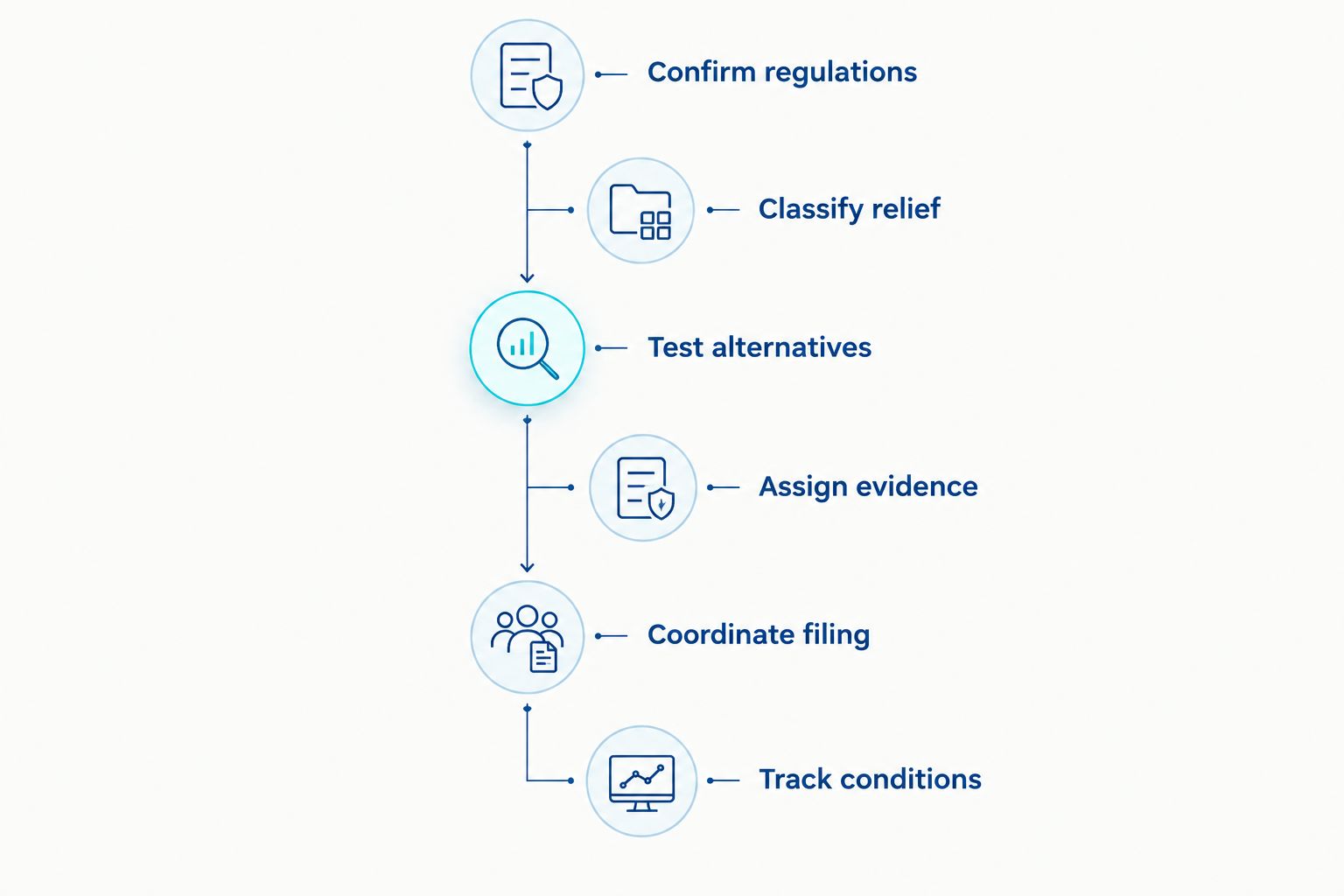
Organize the work around decision milestones. The objective is to identify the correct relief before committing to drawings and testimony built around the wrong approval path.
- Confirm regulations. Identify the zoning district, permitted uses, dimensional standards, and applicable redevelopment provisions. Review prior approvals and their conditions with counsel.
- Classify relief. Prepare a zoning schedule comparing the proposed project with each applicable requirement. Have counsel and the relevant licensed professionals distinguish subsection (c) relief from subsection (d) relief.
- Test alternatives. Compare the proposed program with a conforming design or a design requiring fewer departures. Record what each alternative changes and which issues remain.
- Assign evidence. Identify who will prepare the legal argument, planning testimony, drawings, and technical reports. Each professional’s work should address the actual relief requested.
- Coordinate filing. Confirm application materials, completeness requirements, hearing procedures, and statutory notice obligations. Where required, notice includes qualifying property owners within 200 feet, along with other recipients specified by law.
- Track conditions. After a decision, review the written resolution and any conditions before advancing to subsequent permits. A favorable hearing vote does not authorize construction by itself.
Nieves Development provides real estate development consulting in New Jersey for strategy and municipal-process coordination. That role can organize dependencies and milestones, while licensed professionals remain responsible for their respective professional services.
Can a dimensional problem require a use-type variance?
Yes. Not every departure involving building size or development intensity is a subsection (c) bulk variance. Subsection (d) also addresses specified departures involving conditional-use standards, floor area ratio, density, and certain height increases.
Floor area ratio measures building floor area relative to lot area. Density generally concerns the amount of development, such as dwelling units relative to site area; neither issue should be classified solely by calling it a bulk problem.
Classify the statutory relief, not the everyday label. A project with a permitted use can still require subsection (d) relief, although the precise legal test depends on the applicable subsection.
Does a bulk variance need fewer board votes?
Yes, bulk relief generally follows the ordinary majority-of-members-present rule, provided a quorum exists. When all 7 voting members participate, that ordinarily means 4 affirmative votes, compared with the 5 affirmative votes required for subsection (d) relief.
Attendance, disqualification, and substitute-member participation require procedural attention. Counsel should confirm who is eligible to vote on the application and whether the required threshold has been met.
Is redesigning better than seeking a use variance?
Redesigning is the better route when it produces an acceptable project that complies with the applicable regulations. Its limitation is that dimensional redesign alone cannot make a prohibited use permitted.
Compare the alternatives against the same criteria: permitted use, required relief, physical feasibility, and the owner’s development objectives. Do not assume that removing one setback variance resolves an underlying use restriction.
FAQ
Is a use variance harder to get than a bulk variance in New Jersey?
Yes, a use variance generally has a higher legal burden than a bulk variance in New Jersey. A conventional use variance requires special reasons, satisfaction of the negative criteria, and at least 5 affirmative zoning-board votes.
Can a planning board approve a use variance?
A New Jersey planning board generally cannot grant a use variance under N.J.S.A. 40:55D-70(d). That relief belongs to the zoning board of adjustment; counsel should confirm jurisdiction for the complete application.
Do I need a hardship to get a bulk variance?
Not every bulk variance requires the hardship showing associated with subsection (c)(1). Subsection (c)(2) provides a separate route based on advancing zoning purposes and benefits that substantially outweigh the detriment, together with satisfaction of the negative criteria.
Does a permitted use mean I only need bulk variances?
No, a permitted use can still require subsection (d) relief for specified departures involving development intensity or other regulated features. Have the project’s complete zoning schedule reviewed before selecting the approval path.
Does zoning approval let me start construction?
No, zoning approval alone does not authorize construction. Review the written resolution, approval conditions, required permits, and applicable inspections before starting work.
Can a zoning consultant replace my land-use attorney?
No, development consulting and municipal-process coordination do not replace legal representation or licensed professional services. Nieves Development coordinates strategy and process; retain the appropriate attorney and licensed professionals for legal advice, technical work, and testimony.
What should I check before buying a property in 2026?
Before buying a property in 2026, confirm permitted uses, dimensional requirements, prior approvals, redevelopment provisions, and the likely relief required. Coordinate those findings with counsel and the licensed professionals evaluating the proposed project.
One last thing
A small-looking deviation can follow a more demanding statutory path than its appearance suggests. Before your next acquisition or design milestone in 2026, request a written zoning schedule that identifies each departure, its statutory category, and the professional responsible for addressing it.
This article provides general New Jersey development-process information, not legal advice or licensed engineering, architectural, planning, or surveying services. Obtain property-specific advice from qualified counsel and the appropriate licensed professionals; no approval outcome is guaranteed.
Related guides
- Can you build multifamily housing without a variance?
- How long does a zoning variance approval take in NJ?
- Paterson zoning due diligence before property acquisition
YOUR NEXT STEP
Planning a project in New Jersey?
Discuss your property, project goals and municipal-process questions with Nieves Development Consulting.
Explore our consulting services · See a Paterson project example