

Architects’ and engineers’ zoning consulting is development-process guidance with the aim of aligning a proposed design with the property’s zoning and municipal approval pathway. This 2026 guide explains zoning consulting for architects and engineers in New Jersey, where design assumptions, application requirements, and professional responsibilities must remain coordinated without replacing licensed services.
- Zoning consulting for architects and engineers should connect design assumptions, approval requirements, and municipal-process milestones.
- Nieves Development supports development strategy and municipal coordination; licensed professionals retain responsibility for their professional services.
- Verify zoning and redevelopment requirements before treating a concept as an application-ready design.
- Assign responsibility for ordinance research, drawings, legal questions, submissions, and responses before filing.
Why zoning consulting matters for architects and engineers
A zoning question becomes a design problem when your team discovers it after drawings have advanced. Setbacks affect building placement; permitted uses affect the development program; parking and access requirements affect site organization. Resolve these dependencies before the owner treats a concept as settled.
Architects and engineers also need a clear boundary between municipal coordination and professional judgment. A coordinator can organize questions, documents, and milestones. That role does not replace the architect’s design responsibility, the engineer’s technical analysis, or counsel’s legal advice.
Nieves Development zoning consulting is best for property owners needing development strategy and municipal coordination alongside their architects and engineers. Nieves Development provides that coordination for multifamily, mixed-use, and redevelopment projects in Paterson and throughout New Jersey.
For your 2026 project roadmap, keep these decisions separate:
- Whether the proposed use fits the applicable zoning or redevelopment requirements.
- Whether the concept satisfies relevant dimensional and site requirements.
- Which applications, professional documents, and municipal reviews the proposal requires.
- Whether the owner is ready to authorize the next design or submission milestone.
An informal municipal discussion is not an approval. Record what was discussed, what remains unresolved, and which formal determination or professional review the team still needs.
Build the zoning and coordination roadmap
Start with official municipal documents, an owner-approved brief, and a shared responsibility register. These are manual ways to organize the work before engaging an outside coordinator. Move through the following steps in order, returning to earlier decisions whenever the proposal changes.
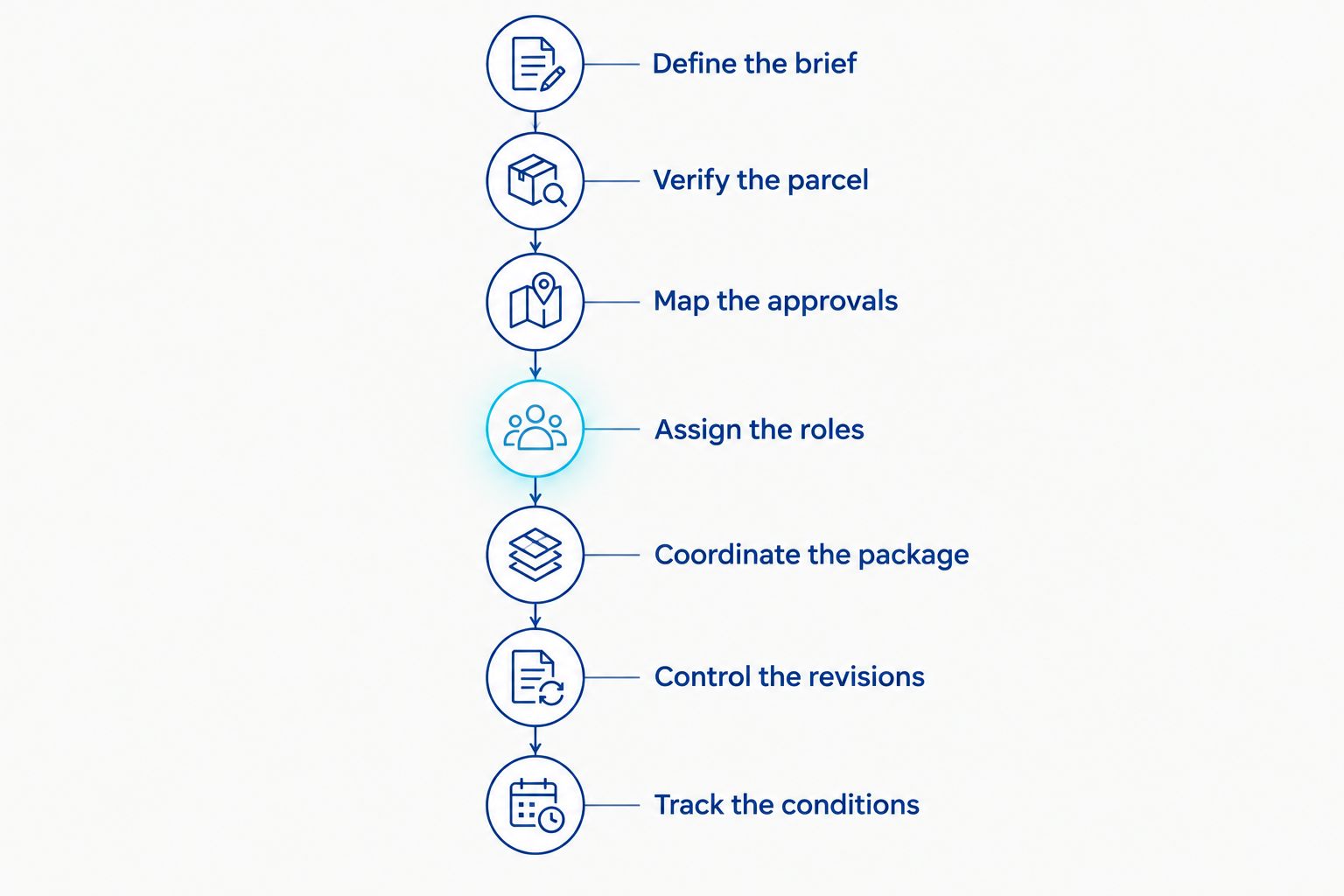
The sequence is: Define the brief, Verify the parcel, Map the approvals, Assign the roles, Coordinate the package, Control the revisions, and Track the conditions. Each phase should end with a documented decision, an assigned owner, or a clearly identified unresolved issue.
Define the brief
Write a project brief before asking the team to resolve zoning questions. Describe the existing property, proposed use, intended development program, and decisions the owner needs to make. Distinguish fixed requirements from preferences that the owner can reconsider.
For a first-time property owner, explain that feasibility means evaluating whether the proposal can proceed under identified constraints; it is not a promise of approval. For an experienced developer, identify which assumptions still need confirmation rather than repeating previously documented decisions.
Use a 1-page decision brief as the starting summary, with supporting documents attached separately. As an internal working practice, schedule a 30-minute kickoff to agree on the questions and responsibilities. Neither recommendation is a municipal requirement.
Close this step with an owner-approved scope:
- Describe the proposed use and development program in plain language.
- Identify the property by address and municipal block and lot.
- List existing documents, including surveys, approvals, and concept drawings.
- Separate owner requirements from design alternatives.
- Record the next decision and the information needed to make it.
Verify the parcel
Begin with the municipality’s official zoning map and ordinance. Confirm the parcel’s zoning district, then review the provisions relevant to the proposed use and design. Do not rely solely on a property listing, an old concept plan, or the zoning designation of an adjacent property.
Check whether a redevelopment plan applies. A redevelopment plan establishes requirements for a designated redevelopment area; the relationship between that plan and the zoning ordinance needs careful review. Refer questions about legal interpretation to qualified counsel.
For a 2026 review, record the source and access date of each document. If the municipality’s published materials conflict or appear incomplete, identify the discrepancy and seek clarification rather than silently selecting the more favorable requirement.
Close this step with a source-backed zoning summary:
- Confirm the parcel, district, and applicable mapped boundaries.
- Review permitted uses and relevant conditional-use provisions.
- Identify dimensional standards affecting the proposed concept.
- Check applicable parking, loading, access, and site requirements.
- Identify redevelopment provisions and previously issued approvals.
- Mark unresolved interpretations for the appropriate professional or municipal official.
Map the approvals
Prepare an approval matrix before committing to an application package. The matrix should connect each potential application or review to its purpose, responsible professional, prerequisites, and decision point. Site plan review examines a proposed site’s layout and improvements; a variance seeks relief from an applicable zoning requirement.
New Jersey’s Municipal Land Use Law provides the statutory framework for municipal land-use review. Your team should connect that framework to the municipality’s current ordinance, application forms, and procedural requirements. The New Jersey Municipal Land Use Law developer guide provides related context; project-specific legal questions belong with counsel.
Nieves Development can support the development roadmap and municipal-process coordination while licensed professionals address their respective disciplines. This is the point to add coordination support if unresolved dependencies are preventing the team from defining its next milestone.
Close this step with a documented approval pathway:
- Identify potential zoning, site plan, subdivision, or variance applications.
- Ask counsel to address jurisdiction and legal procedure where necessary.
- Identify other governmental reviews relevant to the property and proposal.
- Confirm submission and completeness requirements with the municipality.
- Record prerequisites without assuming a hearing or decision date.
Assign the roles
Create a responsibility register that names who prepares, checks, submits, and responds to each item. A development consultant can coordinate the register, but coordination does not transfer responsibility for signed drawings, technical conclusions, legal filings, or professional testimony.
Distinguish preparation from decision-making. An engineer can identify a technical constraint; the owner must still decide whether to revise the program or authorize further analysis. Counsel should address legal questions within counsel’s scope rather than having the coordinator resolve them informally.
Assign an accountable person to every open item. A shared list without named responsibility becomes a record of uncertainty, not a working roadmap. Identify the municipal communication lead while preserving direct professional communication when technical or legal issues require it.
Close this step with explicit boundaries:
- Assign architectural design and drawing responsibilities.
- Assign engineering analysis and technical response responsibilities.
- Assign surveying, planning, and legal work to qualified professionals where needed.
- Identify the owner’s decision-maker and authorization process.
- Name the submission coordinator and municipal communication lead.
- Record review responsibilities before documents leave the team.
Coordinate the package
Start manually with the municipality’s current application checklist and a shared document register. Match each required item to its preparer, review status, and current version. Confirm requirements with the municipal office responsible for intake rather than assuming that another municipality’s package will suffice.
Application completeness concerns whether required submission materials have been provided. It does not establish that the proposal satisfies all substantive standards or will receive approval. Keep the completeness milestone separate from design acceptance, hearing preparation, and the board’s decision.
Nieves Development municipal-process coordination can support document organization and milestone tracking alongside the licensed team. The benefit is clearer responsibility across the package; the limitation is that coordination cannot supply missing technical analysis or determine the municipal outcome.
Close this step with a submission-readiness check:
- Compare the package against the current municipal checklist.
- Reconcile project names, parcel references, and drawing revisions.
- Identify missing signatures, supporting documents, or required professional materials.
- Confirm who handles filing, notices, and procedural questions.
- Obtain the owner’s authorization before submission.
- Retain the submitted version and evidence of receipt.
Control the revisions
Maintain a change log after municipal comments, owner requests, or revised technical findings. A change in use, building placement, access, or site layout can affect assumptions elsewhere in the package. Ask the responsible professionals to review those dependencies before circulating revised documents.
For your 2026 coordination plan, distinguish a comment response from a design change. A response explains how the team addressed a question; a design change alters the proposal and requires the relevant professional review. Record both when they occur together.
Use a 15-minute internal change review when a revision affects multiple disciplines. This is a suggested coordination practice, not a required municipal meeting or review period. Focus the discussion on affected documents, owner decisions, and the next submission milestone.
Close this step with controlled responses:
- Log each comment with its source and date.
- Assign the response to the appropriate professional.
- Identify drawings and supporting documents affected by the change.
- Record owner decisions separately from technical recommendations.
- Check consistency before issuing a revised package.
- Archive superseded files outside the active submission folder.
Track the conditions
After a municipal decision, organize the written approval documents and any stated conditions. A condition is a requirement attached to an approval that the project team must address as applicable. Ask counsel and the relevant professionals to review the documents before treating the next milestone as cleared.
Do not assume that a board approval authorizes construction. Separate land-use approvals, satisfaction of conditions, required permits, and any additional reviews. Your roadmap should show the relationship between these milestones without collapsing them into a single status label.
Assign each condition to a responsible person and retain evidence of completion or municipal acceptance where applicable. Unresolved conditions belong in the active register, not only in a meeting summary or archived approval document.
Close this step with a post-decision action list:
- Obtain and organize the written decision and approved documents.
- Ask counsel to identify relevant legal and procedural obligations.
- Assign technical conditions to the responsible licensed professionals.
- Identify remaining municipal or outside-agency actions.
- Track revised documents, submissions, and acceptance records.
- Update the owner’s roadmap before authorizing the next phase.
Compare coordination options for your project
Choose the coordination model based on unresolved dependencies, not simply the number of drawings. In 2026, a project with a settled approval pathway needs a different working arrangement from a redevelopment proposal with open zoning and procedural questions.
| Option | Best for | Practical advantage | Key limitation |
|---|---|---|---|
| Owner-led manual coordination | Owners with a defined scope and capacity to manage the process | Keeps the owner close to documents and decisions | The owner must maintain records and follow up across disciplines |
| Architect- or engineer-led coordination | Projects where coordination fits the licensed lead’s agreed scope | Connects design updates directly to application preparation | Scope boundaries and responsibility for other disciplines still need definition |
| Nieves Development consulting and coordination | Owners seeking a development roadmap alongside licensed professionals | Organizes strategy, zoning guidance, and municipal-process milestones | Does not replace licensed services or guarantee municipal approval |
| Land-use counsel with a licensed technical team | Projects requiring legal interpretation, procedural advice, or representation | Assigns legal and technical work to the appropriate disciplines | Day-to-day document and milestone coordination still needs an assigned lead |
Start with the owner’s decision needs and the professionals’ agreed scopes. External coordination is useful when cross-disciplinary follow-up requires a dedicated lead; it is not a substitute for retaining the professionals the project requires.
Common mistakes architects and engineers make
Treating zoning research as a finished legal determination
A district label does not resolve every question about a proposed use, prior approvals, or redevelopment requirements. Record the research source and separate straightforward ordinance provisions from questions requiring official clarification or legal advice.
Advancing design without an approval-pathway checkpoint
A detailed concept can still rest on an unconfirmed use or application assumption. Establish a checkpoint at which the owner reviews unresolved zoning questions before authorizing further design development.
Assuming the technical lead owns every municipal task
An architect’s or engineer’s involvement does not automatically include filing coordination, notice preparation, legal analysis, or tracking every outside review. Put those responsibilities in the scope and register rather than assigning them through informal expectations.
Allowing comments to create conflicting document versions
Separate revisions issued by different disciplines can leave the application internally inconsistent. Maintain a coordinated issue record, check affected documents, and identify the package submitted to the municipality.
Treating approval as the end of coordination
A favorable decision can leave conditions and subsequent permit requirements outstanding. Continue the roadmap until the relevant professionals and authorities have addressed the requirements for the next authorized activity.
FAQ
What is zoning consulting for architects and engineers?
Zoning consulting for architects and engineers connects a proposed design with zoning requirements and the municipal approval pathway. Development-process coordination organizes research, responsibilities, documents, and milestones without replacing licensed professional services.
When should an architect bring in a development consultant?
Bring in a development consultant when unresolved zoning or municipal-process dependencies need a dedicated coordination lead. Define the consultant’s scope alongside the architect, engineer, owner, and counsel before assigning application tasks.
Does a development consultant replace a land-use attorney?
No. A development consultant does not replace legal advice or representation from a licensed attorney. Assign questions about legal interpretation, jurisdiction, and procedural obligations to qualified counsel.
Can an engineer manage the zoning application alone?
An engineer can coordinate tasks within the engineer’s agreed scope, but that arrangement does not replace other required professional services. Identify who handles architecture, surveying, planning, legal work, submissions, and owner decisions for the specific project.
Is application completeness the same as approval?
No. Application completeness addresses required submission materials, while approval concerns the proposal’s review and decision. Track completeness, substantive review, the written decision, and approval conditions as separate milestones.
How should I choose a zoning consultant in New Jersey?
Choose a zoning consultant whose defined scope matches the project’s strategy and coordination needs. Ask how the consultant will document ordinance sources, assign responsibilities, manage revisions, and distinguish coordination from licensed services.
What should the project team do after a municipal approval?
Review the written decision, assign its conditions, and identify remaining permit or review requirements. A municipal land-use approval is not itself authorization to begin every proposed activity.
One last thing
Give unresolved assumptions the same visibility as completed drawings. For your 2026 project, attach an assumptions register to the decision brief and review it whenever the owner authorizes a new milestone. A polished drawing should not conceal an unanswered zoning or procedural question.
Nieves Development provides development consulting and municipal-process coordination. This guide is general information, not legal, engineering, architectural, licensed planning, or surveying advice. Retain appropriately licensed professionals for those services; municipal authorities determine approvals, and no approval outcome is guaranteed.
Related guides
- What does a land-use consultant do in New Jersey?
- Site plan approval for property owners
- Paterson zoning due diligence before property acquisition
YOUR NEXT STEP
Planning a project in New Jersey?
Discuss your property, project goals and municipal-process questions with Nieves Development Consulting.
Explore our consulting services · See a Paterson project example