

Yes, a feasibility study is worth it before buying land when your purchase depends on whether a specific development can proceed. It helps you test zoning, site constraints, and the approval pathway before committing to ownership, but it does not replace professional investigations or guarantee municipal approval.
- Is a feasibility study worth it before buying land? Yes, when development feasibility determines your acquisition decision.
- New Jersey zoning due diligence should test the proposed use, development scale, site constraints, and municipal approval pathway.
- Nieves Development Consulting LLC supports development strategy and municipal-process coordination; licensed professionals handle regulated professional services.
- Use the findings to proceed, revise the concept, investigate further, or stop before closing.
Why this matters
Buy land for a supportable development concept, not an assumed approval. A parcel's size and location do not establish that your intended project fits the zoning ordinance or the physical site. A permitted use still needs a layout that addresses applicable requirements and site conditions.
For a New Jersey acquisition in 2026, your first milestone is identifying what must be confirmed before your purchase becomes unconditional. The land acquisition and municipal due diligence workflow provides a related framework for organizing that review.
Experienced developers need a decision record they can share with counsel, designers, and financing partners. First-time owners need the same record, with technical terms explained and unresolved questions assigned to the appropriate professional. Neither benefits from a report that describes potential without explaining the conditions attached to it.
Is a feasibility study worth it before buying land?
A feasibility study is worth doing when an unresolved development question can change your decision to buy. The useful output is not simply a favorable opinion. It is a documented connection between your proposed project, the property's constraints, and the work required to proceed.
Choose the review depth according to the decision you face:
| Review approach | Best for | Main benefit | Main limitation |
|---|---|---|---|
| Preliminary desktop review | Buyers screening a parcel before detailed investigations | Identifies zoning questions and apparent approval issues from available records | Does not establish surveyed conditions, subsurface conditions, or final design compliance |
| Coordinated feasibility review | Buyers evaluating a defined development concept | Connects zoning, site investigations, professional input, and acquisition decisions | Requires a clear scope and coordination across disciplines |
| Purchase without feasibility review | Buyers whose intended transaction does not depend on development potential | Avoids a separate pre-acquisition feasibility assignment | Leaves development assumptions unresolved if the intended use later changes |
A desktop review is useful for deciding whether to investigate further. It is not a substitute for a coordinated review when access, environmental conditions, utility service, or the approval pathway could determine whether your project works.
Purchasing without a feasibility review does not eliminate those questions. It changes when you confront them: after ownership rather than while you still have an acquisition decision to make.
Preliminary review: establish the decision questions
A preliminary review should start with your intended use, not a general request to find out what the land is worth developing. Describe whether you are considering multifamily housing, mixed-use development, redevelopment, or another defined concept. Include the scale you intend to test without presenting that scale as an established entitlement.
An entitlement is a governmental approval or authorization needed to carry out the proposed development. Identifying the entitlement pathway means distinguishing what the ordinance permits from what requires additional municipal action.
The preliminary review should address:
- The property's zoning district and applicable ordinance provisions.
- Whether the proposed use is permitted or requires relief.
- Apparent dimensional requirements, such as setbacks and building height.
- Whether redevelopment provisions affect the property.
- Questions that require records, fieldwork, design input, or legal interpretation.
For a purchase evaluated in 2026, record the ordinance and municipal materials used, including their dates. An undated summary leaves the next professional unable to tell whether the analysis reflects current requirements.
Use preliminary findings to select the next investigation, not to declare the parcel ready for construction. A desktop conclusion is only as useful as its identified limits.
Coordinated review: test the development concept
A coordinated feasibility review brings the intended project and the necessary professional investigations into the same decision process. Its value comes from resolving dependencies: a concept that works under zoning still needs to address access, drainage, utilities, and other applicable site requirements.
A setback is the required separation between a building or other regulated improvement and a specified property boundary or feature. A variance is relief from a zoning requirement. Neither a conceptual drawing nor an expectation of receiving a variance establishes approval.
The review should distinguish these findings clearly:
- Confirmed: supported by an identified document, investigation, or professional conclusion.
- Assumed: used to test the concept but not yet verified.
- Unresolved: requires further information before the acquisition decision.
For example, an available tax map helps identify a parcel but does not replace a boundary survey. A conceptual layout helps test a development idea but does not replace engineered plans. These distinctions prevent preliminary material from becoming an unsupported basis for closing.
The coordinated review is the better fit when several unresolved conditions determine the project's viability. Its limitation is equally clear: coordination cannot replace the licensed work required to establish technical or legal conclusions.
How should you organize feasibility before closing?
Use a sequence that connects each investigation to an acquisition milestone. For your 2026 review, assign an owner to every unresolved question and define the evidence needed to close it.
- Define the concept. State the intended use, approximate development program, and essential project requirements. Identify what would make the acquisition unsuitable for your objective.
- Check zoning. Review applicable zoning and redevelopment provisions. Separate permitted development from proposals requiring relief or other municipal action.
- Test site constraints. Identify the investigations needed for boundaries, access, environmental conditions, drainage, utilities, and physical suitability. Assign technical conclusions to qualified professionals.
- Map approvals. Identify the anticipated municipal process and applicable outside-agency questions. Record which matters need confirmation rather than treating the pathway as settled.
- Set the decision. Consolidate findings into a proceed, revise, investigate further, or stop recommendation. Have counsel address how the purchase agreement supports the required investigations and decisions.
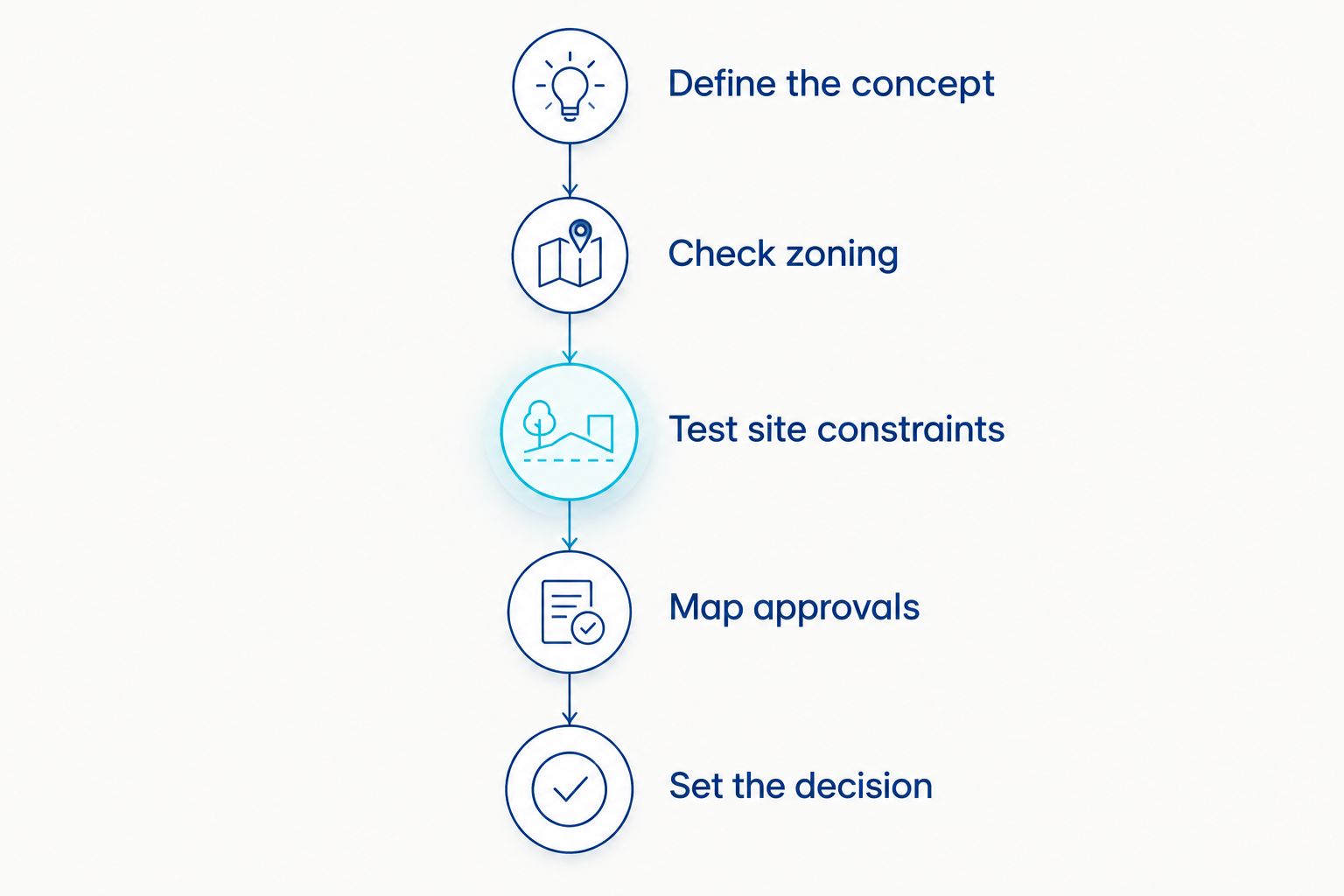
Your roadmap should also explain dependencies. If the proposed layout relies on an unconfirmed access arrangement, the layout remains conditional until the appropriate review resolves that issue. Labeling the dependency is more useful than presenting the concept as complete.
Do not treat an informal municipal discussion as a formal approval. Record what was discussed, what remains subject to application review, and which professional must address the next question.
Why feasibility study scope varies
The appropriate scope depends on the proposal and the evidence already available. Specify the decision the study must support before requesting an assignment. Otherwise, a narrow screening review and a multidisciplinary investigation can appear interchangeable when they answer different questions.
- Proposed use: Multifamily, mixed-use, and redevelopment concepts raise different ordinance and application questions.
- Zoning fit: A proposal that fits applicable requirements needs a different analysis from one that depends on relief.
- Site uncertainty: Missing boundary information, unresolved access, or environmental questions require additional investigation.
- Redevelopment provisions: An applicable redevelopment plan needs review alongside the proposed development program.
- Existing documentation: Surveys, prior approvals, recorded instruments, and technical reports need assessment for relevance to the current proposal.
- Decision timing: The acquisition schedule determines which questions must be answered before the next contractual milestone.
For a 2026 acquisition, use this list to define deliverables rather than asking for a generic report. Request the documents reviewed, assumptions used, unresolved issues, professional referrals, and recommended next actions.
A lengthy report without a decision framework is not inherently more useful. A focused review that identifies a critical unresolved condition can provide a clearer basis for deciding what to do next.
Is checking zoning enough before buying land?
No. Zoning review addresses whether the proposed use and development characteristics fit applicable land-use rules; it does not establish that the site can physically accommodate the project.
A permitted multifamily use, for example, still requires a workable concept addressing applicable site and building requirements. Boundary conditions, access, utility questions, and environmental constraints need their own evidence.
The zoning consulting guide for multifamily developers explains a related part of this review. Keep zoning findings separate from technical findings, then connect them in the acquisition decision.
Treat permitted use as a starting condition, not a complete feasibility verdict. That distinction applies whether you are evaluating your first parcel or adding to an established development pipeline.
Should you study feasibility before making an offer?
Start screening before an offer when the proposed use is central to your decision. Then have your attorney address investigation rights, contingencies, and contractual deadlines before you rely on access or a review period.
An offer and a completed feasibility review do not have to be the same milestone. The essential requirement is that the contractual structure supports the investigations you need before becoming obligated to proceed.
If the available review period does not support an essential investigation, identify that conflict explicitly. Do not convert an unanswered question into a favorable assumption simply to keep the acquisition schedule intact.
Where development consulting fits
Nieves Development Consulting LLC is a fit for New Jersey multifamily, mixed-use, and redevelopment buyers who need development strategy and municipal-process coordination. Its role fits the roadmap between the acquisition objective, zoning questions, professional assignments, and municipal milestones.
The benefit of development consulting is an organized process: defined questions, assigned responsibilities, and a record of readiness. The limitation is that development consulting does not itself establish licensed technical or legal conclusions, and coordination does not guarantee approval.
Nieves Development Consulting LLC's development consulting should therefore sit alongside, not replace, the appropriate professional team. Your acquisition decision should identify who is responsible for each substantive conclusion and which findings remain preliminary.
Professional-services disclaimer: Development consulting and municipal-process coordination are distinct from licensed legal, engineering, architectural, planning, and surveying services. Obtain those services from appropriately licensed professionals where required; use qualified environmental professionals for environmental investigations. This article provides general process guidance, not a property-specific approval or professional opinion.
FAQ
Is a feasibility study worth it before buying land in New Jersey?
Yes, when your purchase depends on whether a proposed development can proceed. A feasibility review connects zoning, site constraints, and the approval pathway to your acquisition decision without guaranteeing approval.
What’s the difference between a feasibility study and zoning due diligence?
A feasibility study addresses the broader development decision, while zoning due diligence examines applicable land-use requirements. The broader review also identifies site investigations, professional assignments, and approval dependencies.
Can a feasibility study guarantee planning board approval?
No, a feasibility study cannot guarantee planning board approval. It identifies the anticipated pathway and unresolved issues, but municipal decisions remain subject to the applicable application and review process.
Do I need a survey before deciding whether to buy land?
Obtain a survey when your acquisition decision requires verified boundary or site information. A tax map or conceptual layout does not replace a survey; have the appropriate professional determine the necessary scope.
What should a land feasibility report include?
A land feasibility report should connect the proposed project to documented findings, assumptions, unresolved questions, and next actions. Request a decision recommendation and identify the professional responsible for each technical or legal conclusion.
Can a development consultant replace my engineer or attorney?
No, development consulting does not replace licensed engineering or legal services. Nieves Development Consulting LLC provides development strategy, zoning guidance, and municipal-process coordination alongside the appropriate professional services.
When should I update a feasibility review for a 2026 purchase?
Update the review when the proposed project, relevant property information, or applicable requirements change. Confirm that the documents and assumptions supporting the acquisition decision still apply before relying on earlier findings.
One last thing
Ask for a stop-condition list before requesting the final recommendation. Identify which unresolved findings would make the proposed acquisition unsuitable, which would require a revised concept, and which need further professional investigation.
That list makes the report actionable. A finding that changes your decision is more useful than a favorable summary that leaves the decisive assumption untested.
Related guides
- Feasibility studies for first-time developers
- Connecting feasibility studies to lender underwriting
- Paterson zoning due diligence for property acquisition
YOUR NEXT STEP
Planning a project in New Jersey?
Discuss your property, project goals and municipal-process questions with Nieves Development Consulting.
Explore our consulting services · See a Paterson project example