

Environmental review adds time to a New Jersey development project when an environmental finding, investigation, or permit becomes a prerequisite for the next project milestone; there is no single duration that applies to every site. In 2026, the practical measure is the time environmental work adds to your project’s critical path, not simply how long a consultant spends preparing a report. Follow-up testing, design changes, and separate agency decisions belong in that assessment too.
- How much time does environmental review add to a project? Measure the effect on project milestones, not report preparation alone.
- New Jersey Department of Environmental Protection permits and environmental due diligence are separate workstreams; identify which your site requires.
- Nieves Development Consulting LLC suits New Jersey owners needing development-process coordination, not licensed environmental assessment or remediation.
- Confirm environmental dependencies before committing to acquisition, financing, municipal submission, or construction dates.
Why this matters
A report delivery date is not necessarily a site-readiness date. You need to know whether the findings support your proposed use, require additional investigation, or change the sequence of approvals and construction.
For a 2026 development schedule, connect environmental tasks to specific decisions rather than placing a single environmental-review allowance on the calendar. The NJDEP environmental review to site plan approval workflow addresses that coordination between environmental work and municipal review.
The scheduling question is not just when the report arrives. It is what your project can do after it arrives.
How much time does environmental review add to a project?
Environmental review adds the elapsed time needed to resolve an environmental dependency that would otherwise prevent your next milestone. Work completed alongside design or municipal preparation does not necessarily extend the overall schedule; work that blocks closing, submission, financing, or construction does.
The critical path is the sequence of dependent tasks that determines the earliest completion date. Establish that sequence before assigning an environmental allowance.
| Environmental workstream | Best for answering | What it contributes | Scheduling limitation |
|---|---|---|---|
| Phase I environmental site assessment | Initial acquisition and lender due diligence | Reviews site history, records, and observable conditions to identify potential environmental concerns | Does not ordinarily include sampling or establish the full extent of contamination |
| Targeted environmental investigation | Resolving concerns identified during preliminary review | Uses a defined investigation scope to assess suspected conditions | Findings can require further investigation or changes to the proposed response |
| Environmental permit review | Evaluating work subject to an applicable environmental permit | Addresses the requirements of the relevant permitting program | Depends on the permit type, submission readiness, and agency review |
| Remediation planning and implementation | Addressing contamination affecting the project | Establishes and carries out the applicable response | Completion of a planning document does not mean all implementation obligations are complete |
These workstreams are not interchangeable, and not every project requires all of them. A lender’s environmental due-diligence request does not establish the full set of environmental permits or remediation obligations for a development.
For your 2026 baseline, document the required workstream, its deliverable, and the milestone it controls. Then ask the responsible professional for a scope-based schedule rather than applying a generic duration to every site.
Initial due diligence: establish what requires investigation
An environmental site assessment and a development feasibility review answer different questions. Environmental due diligence examines environmental conditions and potential concerns; development feasibility considers whether the proposed project works within its broader constraints.
A Phase I environmental site assessment generally reviews records, site history, site observations, and interviews. A recognized environmental condition is an environmental concern identified under the assessment framework that warrants professional attention; it is not a complete measurement of contamination.
Use initial due diligence to identify the next decision, not to assume the site is cleared for construction. Ask the environmental professional to explain what the report concludes, what it does not establish, and whether additional investigation is recommended.
Before acquisition, connect those findings to access rights and contract milestones with your attorney. If further investigation requires access that the seller has not authorized, a technically ready consultant still cannot complete that fieldwork.
Investigation and remediation: separate findings from resolution
Sampling and laboratory analysis address questions that a records-based assessment cannot settle. The scope depends on the concern being investigated, the property conditions, and the proposed work.
Investigation does not always end with the first set of results. An environmental professional determines whether the information adequately defines the issue or whether additional work is needed.
For New Jersey projects involving remediation, confirm the applicable New Jersey Department of Environmental Protection requirements and whether a Licensed Site Remediation Professional, or LSRP, is required. Development coordination does not replace that professional’s technical or regulatory responsibilities.
Your schedule should distinguish investigation, response planning, implementation, and required documentation. Treating these as a single report task hides the dependencies that matter to financing and construction readiness.
Environmental permitting: identify the actual approval path
Environmental permitting is separate from deciding whether a property has contamination concerns. Proposed work affecting regulated wetlands, flood hazard areas, or other regulated resources requires a project-specific assessment of applicable requirements.
A municipal site-plan application and an environmental permit application serve different purposes. Do not treat municipal approval as proof that every environmental authorization is complete.
For a 2026 submission, have the appropriate professionals identify the relevant permitting programs and the information each application needs. Coordinate shared drawings and supporting documents so the project description remains consistent across submissions.
Schedule from the actual permit requirements, not the general label “environmental review.” That label is too broad to support a dependable construction-start commitment.
Why environmental review time varies
The duration changes with the work required and its relationship to other project tasks. These factors belong in your scheduling discussion:
- Site history and existing information. Prior uses, existing reports, and unresolved findings determine what the environmental professional must evaluate.
- Investigation scope. Records review, site access, sampling, laboratory work, and interpretation are different activities with different dependencies.
- Applicable permits. The proposed disturbance and regulated site features determine which permitting questions require resolution.
- Submission readiness. Missing drawings, inconsistent project descriptions, and unanswered technical questions prevent a complete response to review requirements.
- Design changes. Revisions to grading, access, building placement, or utilities require the team to check whether environmental documents still match the proposal.
- Milestone sequencing. The same environmental task has a different schedule effect when it runs alongside design than when it must finish before another task starts.
Ask for each factor to be tied to a named responsibility and deliverable. “Environmental pending” is a status description, not a usable roadmap.
Build an environmental-review roadmap around milestones
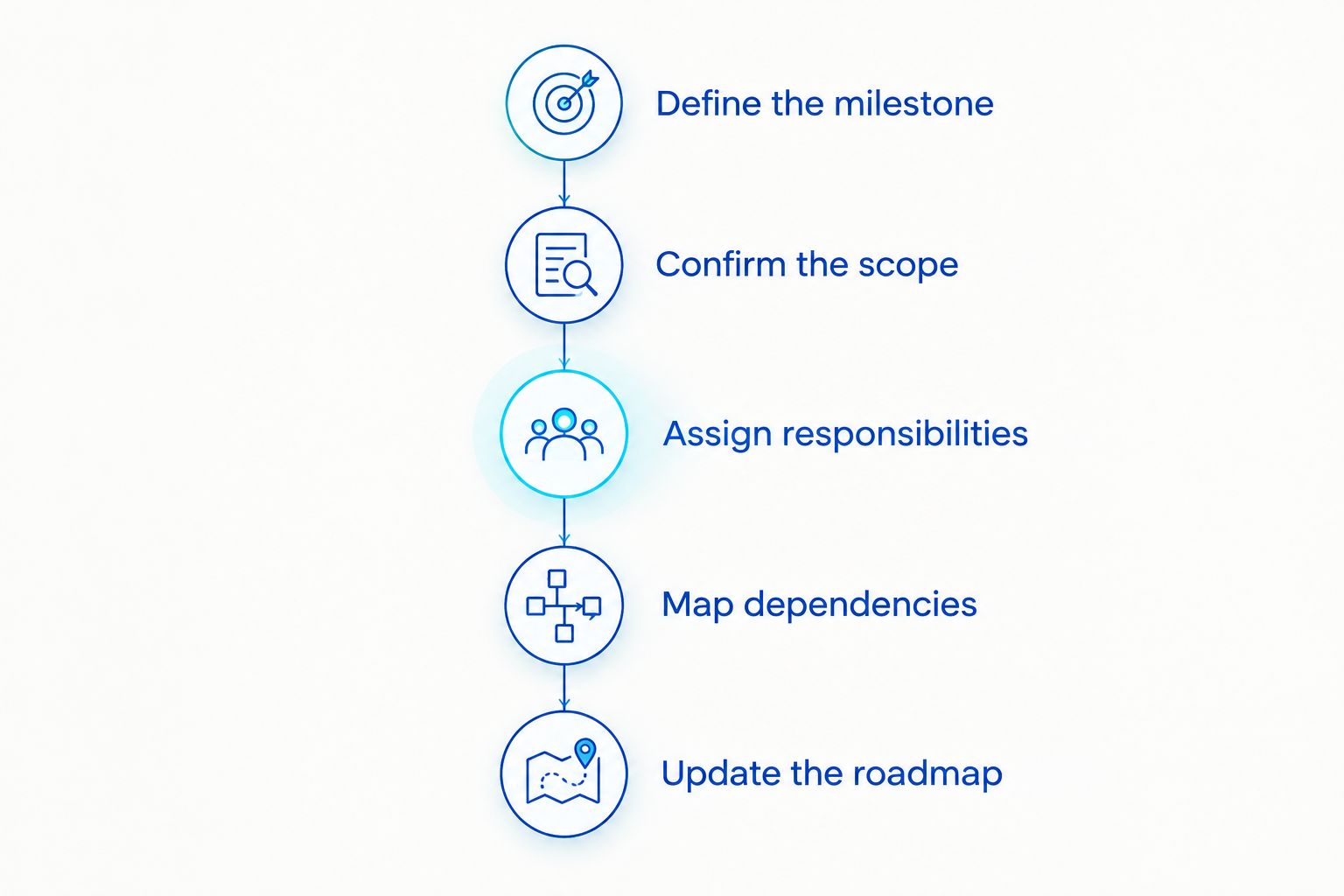
Use the following sequence to turn an uncertain review period into a coordinated project schedule. The sequence organizes responsibilities; it does not establish agency deadlines or guarantee approval.
- Define the milestone. Identify whether you are scheduling acquisition, lender acceptance, municipal submission, permit issuance, or construction commencement. State the exact decision environmental work must support.
- Confirm the scope. Ask the environmental professional to identify the required assessment, investigation, permit work, or remediation activity. Separate confirmed requirements from questions still under evaluation.
- Assign responsibilities. Identify who obtains records, authorizes access, prepares drawings, performs technical work, and responds to comments. Distinguish coordination responsibilities from licensed professional responsibilities.
- Map dependencies. Record which tasks can proceed together and which require an earlier finding or approval. Make environmental prerequisites visible within the broader development schedule.
- Update the roadmap. Revise the sequence when findings, agency comments, or design decisions change the work. Preserve the distinction between a target date and a confirmed completion milestone.
The result should show why a date is achievable, not merely display a date. For your 2026 project, retain the assumptions behind the baseline so later changes have a clear explanation.
What should you ask before accepting a timeline?
Ask the environmental professional what the proposed completion date actually covers. A date for submitting a report is different from a date for receiving agency comments, completing fieldwork, or satisfying a lender’s condition.
Use a short readiness checklist:
- What deliverable marks completion of the current scope?
- What information or access must the owner provide first?
- Which activities depend on findings that are not yet available?
- Does the schedule include responses to comments or only the initial submission?
- Which project milestone cannot proceed until this work is complete?
- Who confirms that the environmental requirement for that milestone has been satisfied?
A useful timeline states its assumptions and its endpoint. If either is unclear, clarify the scope before incorporating the date into contracts or financing commitments.
Nieves Development Consulting LLC is best suited to New Jersey developers and property owners who need development strategy and municipal-process coordination alongside their licensed project team. That coordination supports a shared roadmap; it does not replace environmental investigation, professional certifications, or agency decisions.
Can environmental review run alongside site-plan approval?
Environmental review can run alongside municipal preparation when the tasks do not depend on unresolved environmental findings. Parallel work helps only when the underlying design assumptions remain usable.
For example, preparing a site plan around a proposed disturbance area before evaluating an identified environmental constraint creates a rework risk. Ask the design and environmental professionals which assumptions are sufficiently established for the next submission.
Distinguish preparing an application, submitting it, obtaining approval, and satisfying approval conditions. Those are separate milestones, and the environmental prerequisites need to be checked for each.
Does a clean Phase I report eliminate environmental permitting?
A Phase I environmental site assessment does not replace environmental permitting. Contamination due diligence and permits governing proposed activity address different questions.
A property without identified contamination concerns can still have regulated features relevant to the proposed development. Review the site conditions and construction scope with the appropriate professionals rather than using the Phase I conclusion as a substitute for permit screening.
FAQ
How much time does environmental review add to a project in New Jersey?
Environmental review adds the time needed to resolve environmental prerequisites on the project’s critical path; there is no single duration for every New Jersey site. Establish the required scope and the milestone it controls before assigning a completion date.
Does every development project need a Phase II environmental site assessment?
A Phase II environmental site assessment is not an automatic requirement for every development project. The need for sampling or other investigation depends on the environmental concerns, transaction requirements, and professional evaluation.
Can I close on a property before environmental review is finished?
Closing before environmental review is finished requires a transaction-specific assessment of unresolved risks, contract terms, and lender requirements. Ask your attorney and environmental professional to identify the consequences before committing to the closing milestone.
Does planning board approval mean NJDEP review is complete?
Planning board approval does not establish that applicable New Jersey Department of Environmental Protection requirements are complete. Track municipal approvals and environmental authorizations separately, including conditions attached to each.
What is the best way to avoid environmental-review scheduling surprises?
Identify environmental dependencies before fixing acquisition, financing, submission, and construction dates. Assign each dependency to a responsible professional and distinguish report delivery from completion of the requirement it supports.
Can a development consultant prepare environmental reports or provide legal advice?
Development-process coordination does not replace environmental reporting or licensed legal services. Nieves Development Consulting LLC provides development strategy, zoning guidance, and municipal-process coordination; retain appropriately qualified professionals for technical and licensed work.
One last thing
An environmental report can be complete while the project milestone remains unresolved. Before accepting a completion notice, ask one final question: What decision does this deliverable now allow the project to make?
For a 2026 acquisition or development schedule, record that answer beside the milestone. It keeps a finished document from being mistaken for permission to proceed.
This article provides general development-process information, not legal, engineering, architectural, planning, surveying, or environmental professional advice. Nieves Development Consulting LLC provides development consulting and municipal-process coordination, not licensed professional services. Confirm site-specific requirements with qualified professionals and the relevant authorities; municipal or agency approval is not guaranteed.
Related guides
- How long does municipal due diligence take for land deals?
- How long does site-plan approval take in New Jersey?
- Connecting feasibility studies to lender underwriting
- Site-plan approval to certificate of occupancy workflow
YOUR NEXT STEP
Planning a project in New Jersey?
Discuss your property, project goals and municipal-process questions with Nieves Development Consulting.
Explore our consulting services · See a Paterson project example