
An opportunity zone investment is still worth considering in 2026 when the underlying project works without tax benefits, the investment qualifies, and you can hold it for the required period. For legacy investments, deferred gains generally become taxable no later than December 31, 2026; the separate potential exclusion of qualifying investment appreciation after a 10-year holding period remains the more consequential long-term consideration.
- Is an opportunity zone investment still worth it in 2026? Yes, when project fundamentals and tax eligibility support it.
- Legacy gain deferral ends no later than December 31, 2026; qualifying appreciation receives separate treatment.
- A 10-year holding period does not guarantee returns, liquidity, or municipal approval.
- Nieves Development Consulting LLC provides New Jersey development strategy and municipal-process coordination, not tax advice.
Why this matters
An opportunity zone designation is a federal tax designation, not permission to develop a property. You still need to establish what the site permits, which approvals apply, and whether the project supports its financing and operating assumptions.
For New Jersey investors, the practical starting point is an opportunity zone development strategy that connects acquisition decisions to zoning, project readiness, and municipal milestones. Tax analysis and development feasibility belong in the same decision process, but different professionals must verify them.
Do not accept a weak project because its address sits inside an opportunity zone. A tax benefit cannot correct an unsupported rent assumption, an unresolved environmental condition, or a development program that cannot obtain the necessary approvals.
Is an opportunity zone investment still worth it in 2026?
Yes, when the investment clears both a tax-qualification review and an independent project-feasibility review. It is not a suitable substitute for ordinary underwriting or a short-term place to hold capital.
The federal framework under Internal Revenue Code Section 1400Z-2 separates the treatment of the original deferred gain from the treatment of subsequent qualifying appreciation. For a 2026 investment decision, that distinction is essential: the legacy deferral deadline does not mean every potential opportunity zone benefit ends on that date.
| Investment approach | Best for | Main advantage | Main limitation |
|---|---|---|---|
| Qualified Opportunity Fund investment | Eligible-gain investors with a long holding horizon | Potential exclusion of qualifying appreciation after the required holding period | Qualification requirements, investment risk, and restricted liquidity |
| Direct ownership outside the opportunity zone framework | Investors prioritizing ownership control and flexible structuring | No need to structure the investment around opportunity zone qualification | No opportunity zone treatment simply because the property is in a designated tract |
| Deferring the acquisition decision | Buyers with unresolved site or financing questions | Time to verify feasibility before committing capital | The property or transaction terms can change while diligence continues |
A Qualified Opportunity Fund, or QOF, is an investment vehicle organized to invest in qualified opportunity zone property. Buying a building in a designated census tract does not, by itself, establish eligibility for the federal benefit.
Use the Internal Revenue Service's opportunity zone guidance and Form 8996 instructions with your tax adviser. The statute and applicable regulations—not a property's marketing description—control qualification.
What the federal holding periods actually mean
Legacy gain deferral: December 31, 2026
Under the legacy framework, deferred gain is generally included in income at the earlier of an inclusion event or December 31, 2026. An inclusion event is a transaction or other event that triggers recognition under the applicable rules; it is not limited to receiving a cash distribution.
This creates a cash-planning issue. A tax obligation and an investment distribution are not the same milestone. Before committing, ask how you will fund the liability if the investment remains illiquid when tax becomes payable.
Qualifying appreciation: a 10-year holding period
A qualifying investment held for at least 10 years can receive favorable treatment for appreciation through the applicable basis election. Basis is the tax amount used to determine gain or loss; the election can exclude qualifying appreciation when the relevant requirements are satisfied.
That treatment does not erase the original deferred gain. It also does not guarantee that the investment appreciates, that every distribution receives the same treatment, or that a proposed exit qualifies.
Eligible-gain investment: generally 180 days
Eligible gains generally must be invested in a QOF within 180 days, subject to rules that affect when the period starts. Partnership gains and other circumstances require particular attention rather than a simple count from a property closing.
Have a tax adviser confirm the gain's eligibility, the investment deadline, and the treatment of your specific transaction. A development schedule cannot extend a federal tax deadline.
Federal legislation has also changed the framework for later investment cohorts. Do not apply the legacy December 31, 2026 deadline or legacy holding-period assumptions indiscriminately to every proposed investment; identify the rules governing your actual contribution date.
How to evaluate the investment before committing
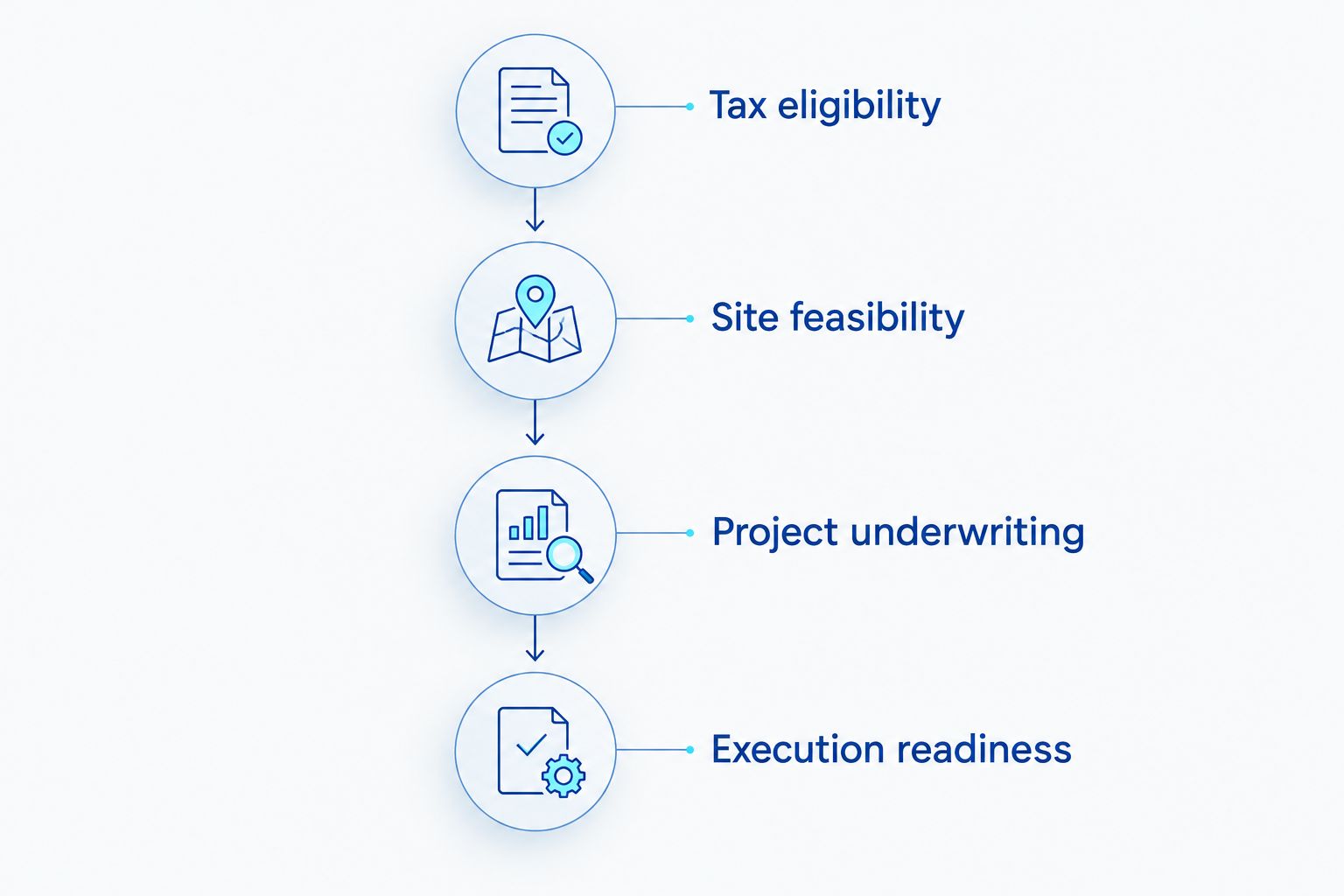
Use a decision sequence that keeps tax eligibility, property feasibility, and financing connected. Each stage should produce a documented conclusion, an unresolved issue, or a reason to stop—not just another presentation.
- Tax eligibility. Identify the eligible gain, contribution timing, ownership structure, and applicable statutory framework. Assign the tax conclusions to a qualified tax adviser before treating any benefit as part of the investment case.
- Site feasibility. Confirm the parcel, zoning district, permitted uses, dimensional standards, access, utilities, and known environmental constraints. Identify whether the proposal needs variances, site plan approval, redevelopment approvals, or outside-agency review.
- Project underwriting. Test acquisition assumptions, construction scope, financing, operating performance, and the exit without assuming an opportunity zone benefit. Then evaluate tax treatment separately rather than using it to conceal weak project economics.
- Execution readiness. Assign responsibility for applications, professional submissions, compliance records, capital contributions, and reporting. Establish what must happen before acquisition, financing, construction, and occupancy.
The sequence matters because a tax-qualified structure can still hold an unworkable development project. Conversely, an attractive property does not automatically fit a compliant opportunity zone investment structure.
For a property acquisition, a feasibility study before buying land helps organize the questions that belong ahead of a binding commitment. Its value is the decision it supports, not the volume of the report.
Keep a written issue register. For each unresolved item, record the responsible professional, the evidence needed, the decision it affects, and whether the purchase agreement provides enough time to resolve it.
Why opportunity zone investment value varies
The designation is only one input. These factors determine whether the structure fits your project and investment objectives:
- Eligible gain and timing. Your gain type, contribution date, and applicable rules determine whether the contemplated tax treatment is available. Establish these before negotiating around a presumed benefit.
- Holding capacity. A 10-year tax milestone requires capital that can remain invested. Review fund transfer restrictions, redemption provisions, and exit authority rather than assuming you can sell when personal circumstances change.
- Fund and property compliance. A QOF generally must satisfy a 90% investment standard for qualified opportunity zone property. Underlying businesses and property also face qualification rules, including applicable original-use or substantial-improvement requirements.
- Municipal readiness. Zoning, redevelopment-plan requirements, hearings, environmental review, and outside-agency permits affect execution. Opportunity zone status does not waive these requirements or determine the reviewing authority.
- Economics and financing. Acquisition assumptions, construction scope, debt terms, reserves, and operating performance determine whether the project can support itself. Review downside scenarios before adding a tax-benefit scenario.
- Exit and tax coordination. Fund documents, asset sales, investor-level elections, and state tax treatment need coordinated review. Federal treatment does not establish the result for every investor or jurisdiction.
Ask the sponsor to separate documented facts from assumptions. A confirmed zoning district, a proposed unit count, and an anticipated approval are different categories of information and should not appear interchangeable in underwriting.
Does an opportunity zone designation make approval easier?
An opportunity zone designation does not grant zoning approval, a building permit, or permission to occupy a building. In New Jersey, the proposed use and physical development still need review under the applicable municipal and state requirements.
For a Paterson redevelopment property, begin with the governing zoning ordinance and determine whether a redevelopment plan applies. A redevelopment plan can establish property-specific development requirements; the federal tract designation does not answer that question.
Assign licensed professionals to the work their disciplines require. A survey establishes different information from an architectural concept, and neither replaces a legal interpretation of approval requirements.
Readiness means knowing the approval path and its unresolved dependencies—not promising an approval date. Keep acquisition and financing milestones tied to evidence of progress rather than an assumed hearing outcome.
Where development coordination fits
Nieves Development Consulting LLC is best for New Jersey investors seeking development strategy and municipal-process coordination. That role is relevant when a multifamily, mixed-use, or redevelopment proposal needs a clear roadmap connecting property diligence, professional work, and municipal submissions.
The advantage of coordination is clarity: which questions remain open, who owns each task, and what must precede the next milestone. The limitation is equally important: coordination does not replace licensed professional analysis, fund compliance work, or the municipality's decision-making authority.
Nieves Development Consulting LLC provides development consulting and municipal-process coordination, not licensed legal, engineering, architectural, planning, or surveying services. Obtain tax advice from a qualified tax professional and investment advice from an appropriately qualified adviser; this article does not provide either.
What should you resolve before making an offer?
Resolve whether the intended use has a plausible approval path, whether the investment structure fits your tax situation, and whether the purchase terms accommodate necessary diligence. Do not leave these as assumptions to be addressed after closing.
Ask for the property's existing approvals and conditions, available surveys and environmental reports, and the proposed fund's governing documents. Have the relevant professionals identify what those records establish and what still requires investigation.
Can an existing opportunity zone investment still have value?
An existing opportunity zone investment can retain value through its underlying performance and potential qualifying appreciation treatment. The December 31, 2026 legacy recognition deadline does not, by itself, determine whether you should sell.
Review remaining capital needs, compliance, holding history, and exit provisions before changing course. A sale made solely to respond to a tax deadline can create a different set of tax and investment consequences.
Should you choose the tax structure before the property?
Choose the tax structure and property through coordinated review, not in isolation. Establish eligibility early, but require the property to pass independent feasibility and underwriting checks before committing.
The strongest decision is one you can explain without leading with the tax benefit. State what the project does, why the site supports it, how execution will be funded, and which risks remain unresolved.
FAQ
Is an opportunity zone investment still worth it in 2026?
An opportunity zone investment is worth considering in 2026 when the project stands on its own economics, the investment qualifies, and the holding period fits your needs. Tax treatment should strengthen a sound investment case, not replace one.
Does the opportunity zone tax benefit end on December 31, 2026?
December 31, 2026 is the legacy deadline for recognizing deferred gains, not a blanket expiration of every opportunity zone benefit. Qualifying appreciation treatment and rules for later investment cohorts require separate analysis.
Do I have to hold an opportunity zone investment for 10 years?
A holding period of at least 10 years is required for the potential qualifying-appreciation basis election. Selling earlier requires analysis of the resulting tax treatment and the investment’s governing documents.
Can I get opportunity zone benefits by buying a property directly?
Buying property in an opportunity zone does not automatically qualify you for federal opportunity zone treatment. Eligible investment through a Qualified Opportunity Fund and compliance with the applicable requirements are essential.
Does opportunity zone status replace New Jersey zoning approval?
Opportunity zone status does not replace New Jersey zoning approval, site plan review, or construction permits. Confirm the property’s municipal approval path independently of its federal tax designation.
Who can help coordinate an opportunity zone development in New Jersey?
Nieves Development Consulting LLC provides development strategy, zoning guidance, and municipal-process coordination for New Jersey projects. Tax, legal, design, engineering, planning, and surveying conclusions require the appropriate qualified or licensed professionals.
One last thing
Ask for two separate roadmaps before investing: one for tax and fund compliance, and another for development execution. Place them side by side and identify where an unresolved property issue threatens a capital or compliance milestone.
For a 2026 decision, this is more useful than asking whether opportunity zones are attractive in general. Invest only when you understand both what qualifies and what must actually get built.
Related guides
- Connect feasibility studies to lender underwriting
- Paterson zoning due diligence before property acquisition
- Connect redevelopment projects to NJEDA incentives
YOUR NEXT STEP
Planning a project in New Jersey?
Discuss your property, project goals and municipal-process questions with Nieves Development Consulting.
Explore our consulting services · See a Paterson project example