

A development feasibility study has no flat rate in 2026: its cost depends on the property, the proposed project, and the investigations included in the engagement. The consulting fee does not automatically include surveys, engineering, environmental investigations, legal review, or municipal application expenses. Define the decision the study must support before comparing proposals; a zoning screen and an acquisition-ready investigation are different assignments.
- How much does a feasibility study cost for a development? Define the scope before comparing fees.
- Nieves Development provides development strategy and municipal-process coordination, not a substitute for licensed professional services.
- Compare zoning due diligence, site investigations, financial assumptions, deliverables, and exclusions separately.
- Use a staged development feasibility study to resolve decision-critical questions before authorizing additional work.
How much does a feasibility study cost for a development?
A development feasibility study costs according to its agreed scope, not a universal project category. Start by identifying whether you need an initial property screen, a coordinated assessment of development constraints, or documentation supporting an acquisition or financing decision.
For baseline consulting pricing, including initial multifamily project scoping, see Engagements & Fees. Technical investigations by licensed professionals are priced separately.
For an initial roadmap, the feasibility studies guide for first-time developers explains the broader assignment. The table below distinguishes possible scopes; these are ways to organize an engagement, not standardized service packages.
| Scope | Best for | Questions to resolve | Useful output | Limitation |
|---|---|---|---|---|
| Preliminary property screen | Deciding whether to investigate a property further | Does the proposed use appear consistent with available zoning and property information? | Initial constraints and follow-up questions | Does not establish physical capacity or approval readiness |
| Coordinated development assessment | Comparing a defined concept against known constraints | Which zoning, site, municipal-process, and professional-review issues need resolution? | Development roadmap with responsibilities and unresolved items | Depends on the documents and professional findings available |
| Acquisition or financing support | Testing assumptions before a transaction decision | Which findings affect the proposed development program and financial assumptions? | Documented assumptions, findings, and outstanding conditions | Does not replace legal due diligence or a lender's own requirements |
A proposal should identify both the work and its boundaries. An engagement described only as a feasibility study leaves too much room for misunderstanding: you cannot tell whether the assignment includes document review, municipal coordination, concept evaluation, or separate professional investigations.
The useful comparison is therefore scope against scope, not one headline fee against another. Ask each provider to identify the decision their deliverable supports and the questions it leaves unanswered.
Why this matters before you commit to a property
A feasibility study should help you decide whether to proceed, revise the development concept, investigate further, or stop. A long report that does not distinguish confirmed findings from assumptions does not provide that decision structure.
For a New Jersey multifamily, mixed-use, or redevelopment project, development readiness depends on more than whether a use appears in an ordinance. The review also needs to identify relevant development standards, site constraints, approval questions, and the professional work needed to evaluate them.
Nieves Development is best suited to developers, property owners, and investors seeking New Jersey development strategy and municipal-process coordination. That role helps organize a roadmap; it does not replace the licensed professionals responsible for legal opinions, design, technical investigations, or surveys.
When commissioning a study in 2026, require the report to identify the documents reviewed and their dates. A conclusion based on an outdated ordinance, superseded concept, or incomplete property record needs a clearly stated limitation.
Preliminary screening: define the first decision
A preliminary screen is best for deciding whether a property warrants further investigation. It should establish the proposed use, identify the applicable zoning information, and record obvious questions that need confirmation.
Provide the property address, parcel identification, available records, and a written description of your concept. Explain whether you are considering new construction, a change of use, an addition, or redevelopment of an existing building. Those descriptions give the reviewer an actual proposal to evaluate.
The advantage is a bounded assignment focused on an early decision. The limitation is equally important: a document-based screen does not establish buildable area, infrastructure capacity, environmental condition, or the feasibility of a final design.
Treat preliminary screening as a decision gate, not permission to proceed with construction. Its deliverable should distinguish apparent compatibility from issues requiring technical review or municipal confirmation.
Coordinated assessment: connect constraints to a roadmap
A coordinated assessment is best for a project with a defined concept and several interdependent questions. The assignment connects zoning guidance, property information, professional findings, and municipal-process requirements into a development roadmap.
For example, a proposed multifamily project needs a clear account of the use and development standards under review. If the concept depends on relief from those standards, the assessment should identify that question rather than describe the project as approved or approval-ready.
The advantage is coordination: you can see which findings affect the concept and which team member needs to resolve each issue. The limitation is dependence on source material. A roadmap cannot turn an unverified site assumption into an engineering conclusion.
For a 2026 engagement, specify how the team will record changes to the concept. Otherwise, a revision to the building program can leave earlier zoning observations or financial assumptions attached to a proposal they no longer describe.
Transaction support: document the assumptions behind your decision
Acquisition or financing support is best for a defined transaction decision. The study should connect the proposed development program to the findings, assumptions, and unresolved conditions that affect that decision.
A financial model, or pro forma, is a projection of development expenses, income, and financing assumptions. It is not evidence that the proposed building can obtain approvals or that the assumed development program fits the site.
The advantage of this scope is traceability: the reader can identify which conclusions support the transaction and which remain conditional. Its limitation is that the study does not replace a lender's review, legal advice, or technical reports requested for the transaction.
If financing is part of your decision, review how feasibility studies connect to lender underwriting. Confirm the intended recipient's requirements before commissioning a report rather than assuming an existing format will satisfy them.
Why development feasibility study scope varies
The following factors change the work an engagement needs to cover. Use them to explain your project when requesting proposals, rather than asking providers to quote an undefined study.
- Project definition: A clear use and development concept gives the team a defined assignment. Multiple concepts require separate assumptions and comparisons.
- Zoning questions: Reviewing apparent compliance differs from evaluating a concept that raises variance or redevelopment-plan questions. A variance is relief from a zoning requirement, not a guaranteed outcome.
- Property documentation: Existing surveys, plans, reports, and municipal records determine what information can be reviewed and what needs verification.
- Site investigations: Environmental, drainage, access, utility, and other technical questions require the appropriate professional assessment when relevant to the property.
- Municipal coordination: Identifying the applicable process differs from coordinating questions, tracking responses, and incorporating them into a roadmap.
- Decision requirements: An early screening decision and a lender-facing or acquisition decision need different supporting documents and levels of detail.
Do not treat every possible investigation as mandatory for every property. Ask the team to explain which questions are material to your concept and why each proposed task belongs in the current phase.
How do you request comparable feasibility study proposals?
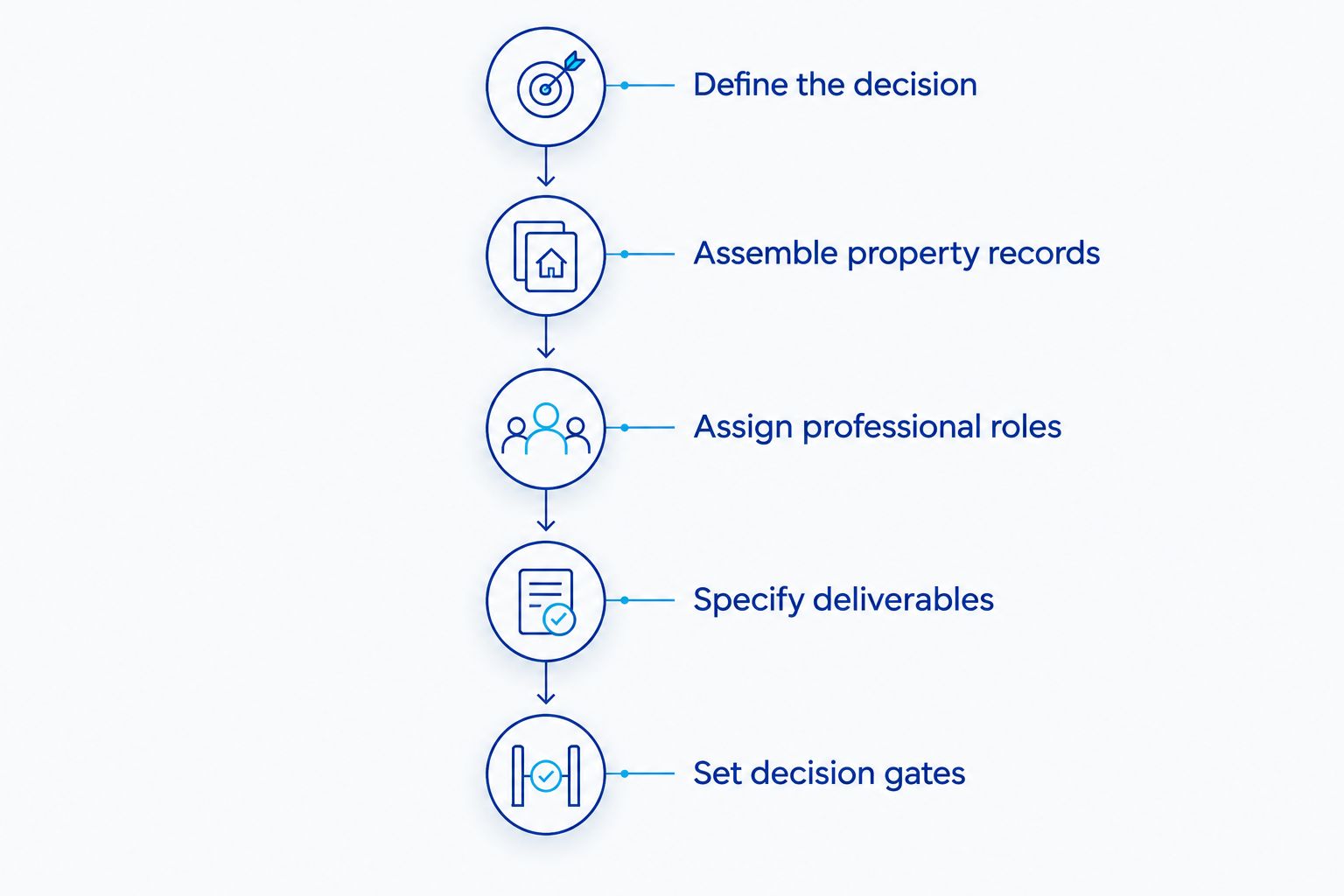
Use a written scope brief before requesting proposals. The brief should describe the property, the concept, the decision, and the available documents. Then ask each provider to respond against the same requirements.
Define the decision
State what you need to decide: whether to pursue a property, change the concept, proceed with an acquisition, or prepare for a municipal application. Include the relevant decision milestone without assuming that a consultant controls municipal scheduling.
Assemble property records
Provide available surveys, deeds, plans, prior approvals, environmental reports, and relevant correspondence. Identify each document's date and whether it reflects current conditions. Do not describe an old plan as a verified existing condition.
Assign professional roles
Separate development consulting and coordination from legal, engineering, architectural, planning, surveying, and environmental tasks. Ask who prepares each deliverable and who is responsible for interpreting technical findings.
Specify deliverables
Request a written findings summary, source list, assumptions, unresolved questions, and recommended next steps. Where coordination is included, require named responsibilities and milestones rather than a general promise to manage the process.
Set decision gates
Identify which finding must be resolved before authorizing the next phase. A decision gate is a defined checkpoint at which you proceed, revise, pause, or stop. It keeps additional work connected to an actual development decision.
For a study commissioned in 2026, put the concept version and document dates in the scope brief. This gives both you and the project team a common reference when the proposal changes.
What should you check before accepting a proposal?
Read the exclusions as closely as the task list. A proposal can describe a useful consulting assignment while excluding the technical work needed to answer your most important property question.
Check whether the engagement includes municipal document review, direct coordination, meetings, revisions, and a written final deliverable. Ask what happens when the review identifies a need for a separate professional investigation or a materially different concept.
For your 2026 scope review, make the following distinctions explicit:
- Included work: The tasks the provider will perform under the engagement.
- External work: Investigations or opinions assigned to other professionals.
- Owner responsibilities: Documents, access, decisions, and authorizations you must provide.
- Revision boundaries: The changes covered by the original scope and those requiring a new authorization.
- Completion milestone: The deliverable or decision checkpoint that closes the assignment.
Nieves Development's stated role covers development strategy, zoning guidance, and municipal-process coordination. When that is the role you need, distinguish it from the separate technical and legal work your project requires.
Is a zoning review enough for a development feasibility study?
A zoning review alone is not a complete assessment of physical and financial feasibility. It addresses the applicable land-use framework, but it does not establish environmental condition, engineering feasibility, structural suitability, or the reliability of financial assumptions.
Use zoning review to identify development constraints and approval questions. Then assign additional investigations according to the decisions your proposed project requires.
Does a feasibility study guarantee municipal approval?
A feasibility study does not guarantee municipal approval. It identifies findings, assumptions, constraints, and a proposed process; the municipality evaluates an application through the applicable procedures.
Treat a favorable feasibility finding as support for the next decision, not as an approval, permit, or professional certification.
Can you commission a feasibility study in stages?
You can define a feasibility study as staged work with separate authorizations. Start with the questions that determine whether further investigation is justified, then commission additional work when its purpose is clear.
Staging requires coordination: document what each phase establishes and what remains unresolved. Otherwise, separate reports can leave gaps between the zoning assumptions, technical findings, and financial model.
FAQ
How much does a feasibility study cost for a development in 2026?
A development feasibility study has no flat rate; the engagement depends on the property, proposed concept, investigations, and deliverables. Define a common scope before comparing proposals, and separate consulting work from outside professional investigations.
What’s the best feasibility study scope before buying land?
The best scope answers the questions that control your acquisition decision. Identify zoning, site constraints, approval questions, and required professional investigations before authorizing the assignment.
Is a feasibility study the same as a site plan?
A feasibility study is not the same as a site plan. A feasibility study evaluates development questions and assumptions; a site plan is a project drawing used to communicate proposed site development, with preparation and submission requirements determined by the applicable process.
Does a feasibility study include an environmental investigation?
An environmental investigation is included only when the engagement expressly assigns that work. Document review or coordination does not replace an environmental professional’s investigation.
Can a feasibility study tell me how many apartments I can build?
A feasibility study can evaluate a proposed apartment program, but a preliminary estimate is not an approved unit count. Zoning standards, site conditions, design, and required approvals need appropriate review.
Who coordinates the different professionals involved?
The engagement should name the party responsible for coordination. Nieves Development provides development strategy and municipal-process coordination, while licensed professionals remain responsible for their assigned professional services.
What should I receive when the study is finished?
You should receive the agreed deliverables, with findings, sources, assumptions, unresolved issues, and next steps clearly distinguished. The report should explain which decision it supports and what additional work is required.
One last thing
Ask which unresolved finding would change the recommendation to proceed. That question turns a report into a decision tool: it identifies the assumption you need to test before advancing to the next milestone.
For a New Jersey project in 2026, retain that question alongside the study's document dates and concept version. When the project changes, revisit the finding instead of carrying an earlier conclusion into a different proposal.
Development consulting and municipal-process coordination are distinct from licensed legal, engineering, architectural, planning, and surveying services. Obtain the appropriate licensed professionals for opinions, designs, certifications, and other regulated services. A feasibility study does not guarantee municipal approval.
Related guides
- Paterson zoning due diligence before property acquisition
- Land acquisition to municipal due diligence workflow
- Zoning consulting for multifamily developers
YOUR NEXT STEP
Planning a project in New Jersey?
Discuss your property, project goals and municipal-process questions with Nieves Development Consulting.
Explore our consulting services · See a Paterson project example